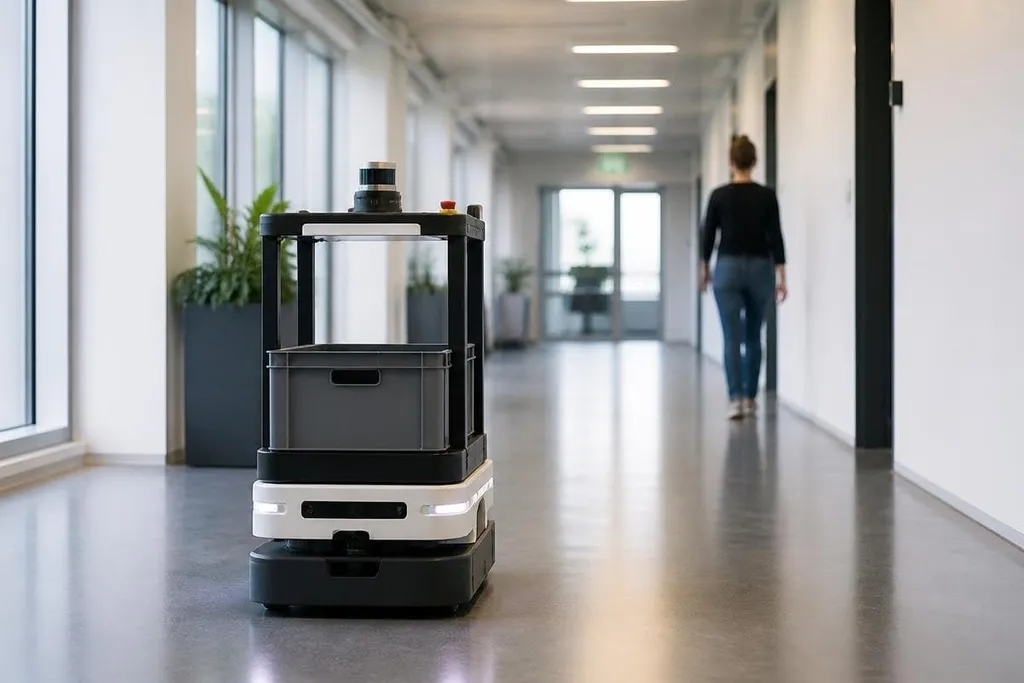
A mobile robot can already move through a mapped building, but AI changes how it deals with the parts no map can predict. The main shift is from fixed instructions toward systems that read sensors, choose actions, and adjust as conditions change.
Quick read
- Better use of cameras, LiDAR, and other sensors
- More flexible routes around people and objects
- Safety limits still depend on testing and clear rules
From fixed routes to live decisions
Traditional mobile robots follow a set route between known points. A warehouse vehicle may use markers, magnetic tape, or a stored map to reach a work area. That approach works well when the floor, shelves, and traffic stay in place.
AI adds a layer that can read the scene as the robot moves. A camera can help identify a person, pallet, door, or fallen object. LiDAR measures distance with laser pulses, giving the robot a three-dimensional view of nearby surfaces.
Its software can then compare sensor data with the map and select a new path. This process often uses simultaneous localization and mapping, or SLAM. SLAM lets a robot estimate where it is while it builds or updates a map. AI does not remove the need for that map. It helps the robot make sense of changes around it.
A person crossing a route shows why that matters. Depending on its software and safety settings, the robot may slow down, stop, or move around the person. The useful change is the decision made from fresh sensor data, rather than a route written in advance.
Learning from more than one sensor
A single sensor leaves gaps. A camera can recognize color and shape, but poor light can reduce what it sees. LiDAR can measure distance in the dark, but it may not tell the robot whether a soft object is a bag or a coat. Wheel sensors can report motion, yet a slippery floor can make those readings wrong.
AI can combine these inputs in a process called sensor fusion. From several imperfect signals, the system builds one estimate. That estimate can guide movement, object detection, and route planning.
The same idea applies to robots that carry items, inspect equipment, or move between rooms. A delivery robot may use its camera to read a sign, LiDAR to keep space from a wall, and wheel data to estimate its speed. Each task still needs rules that set stopping distances and limit motor commands.
Mobile robot claims need a named machine, task, site, and test result behind them. Robot24.com mobile robotics coverage gives you those details, so you can judge what AI changed in the robot’s work before looking at what it still can’t solve.
What AI can’t solve by itself
AI needs useful data. A model trained on clear warehouse aisles may react poorly to glare, smoke, stacked cartons, or a layout it has never seen. The problem can start with perception, then affect the route and the robot’s next movement.
Compute power also matters. A mobile robot has limited battery capacity, and running large models on its onboard computer can add heat and power use. Sending every sensor frame to a remote server can reduce that load, but a weak network can delay a decision.
Safety remains a separate layer. A model may suggest a path, but a control system can still limit speed, stop the motors, or keep the robot outside a marked area. Good design gives safety rules authority over a prediction that looks uncertain.
AI also needs a way to fail clearly. If the robot cannot identify an object or estimate its position, stopping and asking for help may be the correct action. A smooth-looking demo tells you little about that failure case.
A buying checklist for mobile robot AI
Before choosing a system, check the parts that affect your site:
- Name the sensors: confirm the camera, LiDAR, depth sensor, and wheel sensors included in the package.
- Test the network: measure how the robot behaves when wireless service drops.
- Ask about local compute: find out which AI tasks run on the robot and which need a server.
- Check the stop rules: see how speed limits, emergency stops, and blocked routes work.
- Request failure examples: ask for results from poor light, moving people, clutter, and unfamiliar layouts.
A useful pilot should test the places where the robot may get confused, not only the clean route shown in a sales demo. Record stopped runs, manual interventions, battery use, and route changes so the system can be judged against the work it must do.
AI will make mobile robots more flexible when its predictions stay tied to sensors, maps, and firm safety limits. The next purchase decision should rest on failure records from your site, because that is where the robot’s real limits will appear.